
Temporary and Phased Wastewater Treatment
Lots sell before infrastructure finishes. A permanent treatment plant takes longer to permit and build than a sales schedule allows, and the first homes still need service. reUse brings capacity online in the gap — with containerized plants that arrive ready to connect, and permanent plants designed from the start to expand.
The gap between first occupancy and the permanent plant
The sequence catches developers out in the same way every time. Permitting runs longer than planned, site work follows, and the permanent plant commissions months after the first closings were scheduled. Meanwhile the capacity is not there, and homes that are built cannot be occupied.
There are three ways through it, and they are not alternatives so much as stages:
- A temporary plant carries flow for a defined period while the permanent one is built
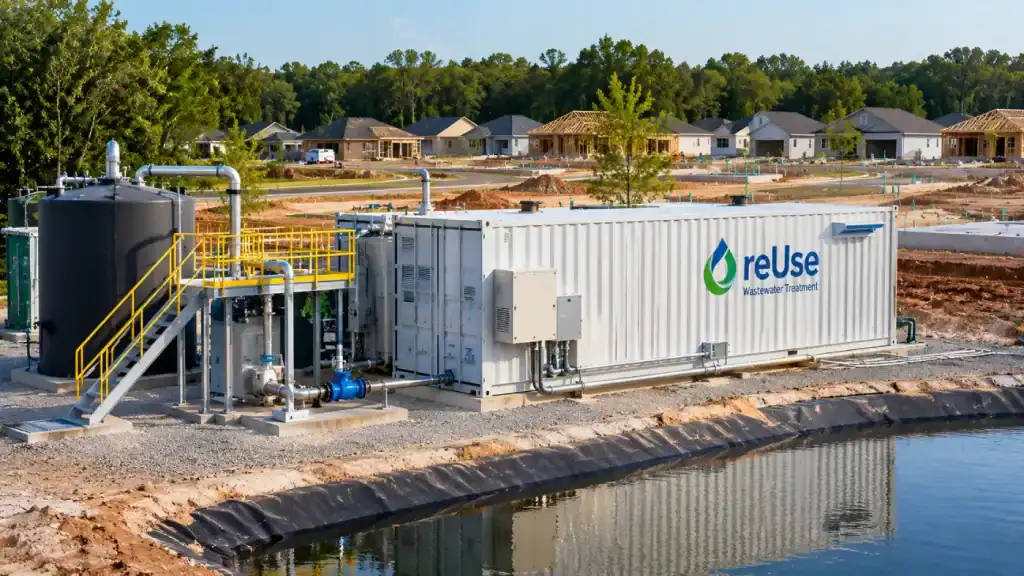
- A containerized plant is assembled and tested at the factory and arrives ready to connect
- A phased permanent plant starts sized for early occupancy and expands as the development fills
- Integrated monitoring and control systems for reliable and predictable performance
Most projects use more than one. The question is which combination fits the buildout schedule.
A temporary plant that let a development start closing
At Hickory Ridge in Elmendorf, Texas, a land developer needed service for the first 135 to 179 homes while the permanent plant was still under construction. reUse installed a 30,000 GPD temporary MBR to carry that load, with a 250,000 GPD Phase 1 plant following behind it.
The temporary unit did what temporary units are for: it removed wastewater capacity from the critical path.
Containerized plants, built in the factory
A containerized MBR is skid-mounted inside a shipping container, assembled and tested before it ships, and connected on site. It suits constrained sites, remote sites and any schedule where site-built construction is the long pole.
At Los Milagros in Cedar Creek, Texas, reUse delivered an 80,000 GPD containerized MBR serving the community.
Phased plants, designed to grow
When the buildout schedule is known, the better answer is usually a permanent plant designed in phases: sized for early occupancy, laid out so later phases add capacity without rebuilding what is already running.
At Windy Hill in Buda, Texas, reUse built a 120,000 GPD plant expandable to 400,000 GPD. At Lakehaven in Farmersville, a 250,000 GPD first phase is operating against a design that scales to 17 MGD, with Phase 2 under construction.
One contract: permitting, design, construction, operations
Permitting a temporary plant and the permanent one that replaces it are usually permitted as one programme, not two.
A temporary plant and the permanent one that replaces it are usually permitted as one programme, not two.
Licensed operators run the plant from day one, through the handover to the permanent plant.
Temporary wastewater treatment plant FAQ
Answers to the most common questions about onsite water reuse, treatment and permitting for data centers.
What is a temporary wastewater treatment plant?
A treatment system installed to carry flow for a defined period, usually while a permanent plant is permitted and built. It is sized for the first phase of occupancy rather than for buildout, and it comes off line or gets repurposed once the permanent plant commissions.
Why would a development need one?
Because lots sell before infrastructure finishes. A permanent plant takes longer to permit and build than the sales schedule allows, and the first homes still need service. A temporary plant lets a developer close on those homes instead of waiting.
What is the difference between temporary, containerized and phased?
Temporary means it carries flow for a defined period. Containerized describes how it is built — skid-mounted inside a shipping container, factory-assembled and delivered. Phased means a permanent plant designed from the start to expand as the development fills. A project can use one, two or all three.
How quickly can a temporary plant be online?
Faster than a site-built plant, because a containerized unit is assembled and tested at the factory and arrives ready to connect. The schedule is usually driven by permitting and site work rather than by the equipment.
What happens to the temporary plant afterwards?
It comes off line when the permanent plant commissions. Depending on the configuration it can be relocated to another phase or another project, which is part of why containerized units suit developers building in stages.
Can a permanent plant be built in phases instead?
Often, and it is usually the better answer when the buildout schedule is known. Phase one is sized for early occupancy and the civil works are laid out for expansion, so later phases add capacity without rebuilding what is already running.
Does reUse handle permitting for a temporary plant?
Permitting is one of the four services reUse delivers, along with design, construction and operations. A temporary installation and the permanent plant that replaces it are usually permitted as one programme rather than two separate efforts.
Our team is ready to help
Tell us your buildout schedule
Send your phasing plan and first-occupancy date and we will tell you what it takes to have capacity ready.