
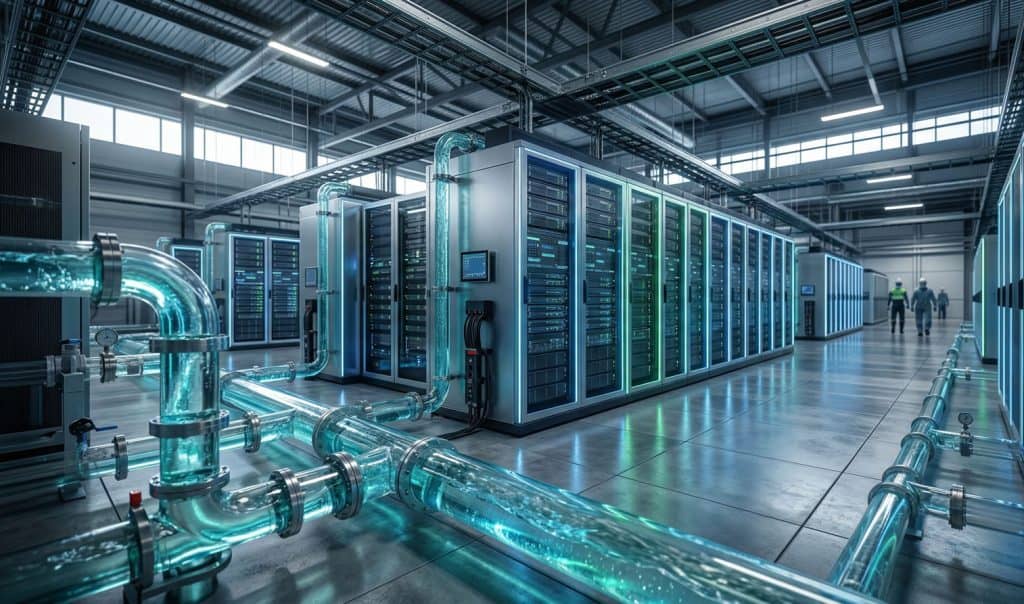
As generative AI and cloud services expand, data centers are rapidly becoming major industrial water users. They require large amounts of electricity and generate heat that must be removed—often using water-based cooling systems. However, water is becoming a limiting resource: by 2025 data centers will be among the fastest‑growing industrial users of freshwater.
At reUse, we help developers and municipalities address this challenge by converting wastewater into a reliable, high-quality water source for cooling
AI growth is expected to significantly increase global water demand in the coming years. Typical facilities need 300,000 gallons of water per day, while large hyperscale sites can use up to 5 million gallons per day, similar to a town of 50,000 residents.
Key takeaway: Without interventions, the water needed to cool AI data centers could strain municipal supplies, amplify drought stress and increase competition with households and agriculture.
The Hidden Water Demand of Data Centers
- Potable water withdrawals – Many data centers still rely on drinking water or groundwater for cooling.
- Evaporative cooling losses – up to 80 % of water withdrawn for cooling evaporates and is lost from immediate use.
- Indirect water use – Because 75 % of data‑center power comes from thermoelectric generation, most of the sector’s water footprint is actually off‑site.
- Water‑scarce locations – Hyperscale data centers cluster in states such as Texas, California and Virginia, where drought risk and population growth already stress supplies.
- Regulatory pressure – States including California, Iowa and Michigan are proposing laws requiring monthly or quarterly water‑use reports. Others, like South Carolina and Kansas, are considering closed‑loop cooling mandates, while Virginia ties tax incentives to the use of reclaimed wastewater.
Why Water Reuse Matters
Water reuse involves treating wastewater and repurposing it for industrial use. When applied to data centers, reclaimed water can reduce freshwater withdrawals by up to 100 %. It also helps secure water supply, reduce permitting risk, and support long-term growth.
How Wastewater Reuse Systems Work
- Wastewater diversion – Used water from municipal sewers or industrial processes is captured before discharge.
- Advanced treatment – Membrane filtration remove solids, pathogens and contaminants.
- Polishing & stabilization – Additional steps adjust pH, remove trace chemicals and ensure quality matches the facility’s cooling requirements.
- Reuse in cooling – Treated water is delivered back to the data center’s cooling towers or closed‑loop systems. In modern designs, blowdown water is treated and reused internally, further minimizing discharge.
Benefits for Communities and Operators
- Preserves potable water
- Reduces environmental impact
- Supports economic growth
- Addresses public concerns
- Accelerates project approvals and reduces infrastructure costs
A Community Example: Sewer Mining in Texas
The Lacy Lakeview City Council in Texas recently examined a proposal to recycle wastewater through a sewer‑mining system to supply cooling water for a planned data center. Residents were concerned about the potential strain on local water supplies, so city leaders explored diverting wastewater, treating it on‑site and delivering it back to the facility. The proposal echoes similar projects across the country and illustrates how local governments can proactively address water security while supporting digital infrastructure.
reUse: Your Partner in Sustainable Data Center Cooling
At reUse, we design and deliver turnkey wastewater reuse systems that can be tailored for data centers—helping you secure reliable water supply while reducing costs and accelerating project timelines.
Our solutions integrate advanced membrane technology, real-time monitoring, and scalable engineering to deliver consistent, high-quality water for reuse applications.
Key advantages include:
- Scalable & Reliable – Systems designed to grow with your project, from single facilities to large regional developments, ensuring a dependable water source at every phase
- Efficient & Cost-Effective – Compact MBR systems reduce footprint, minimize chemical use, and lower both capital and operating costs
- Turnkey Delivery – From permitting to design and construction, we provide a single, accountable partner—delivering everything inside the fence
Take the Next Step
If your project depends on water availability, now is the time to act.
Partner with reUse to:
- Secure a long-term, sustainable water source
- Reduce permitting risk and delays
- Lower infrastructure and operating costs
Contact reUse today to explore how wastewater reuse can support your data center development.

