
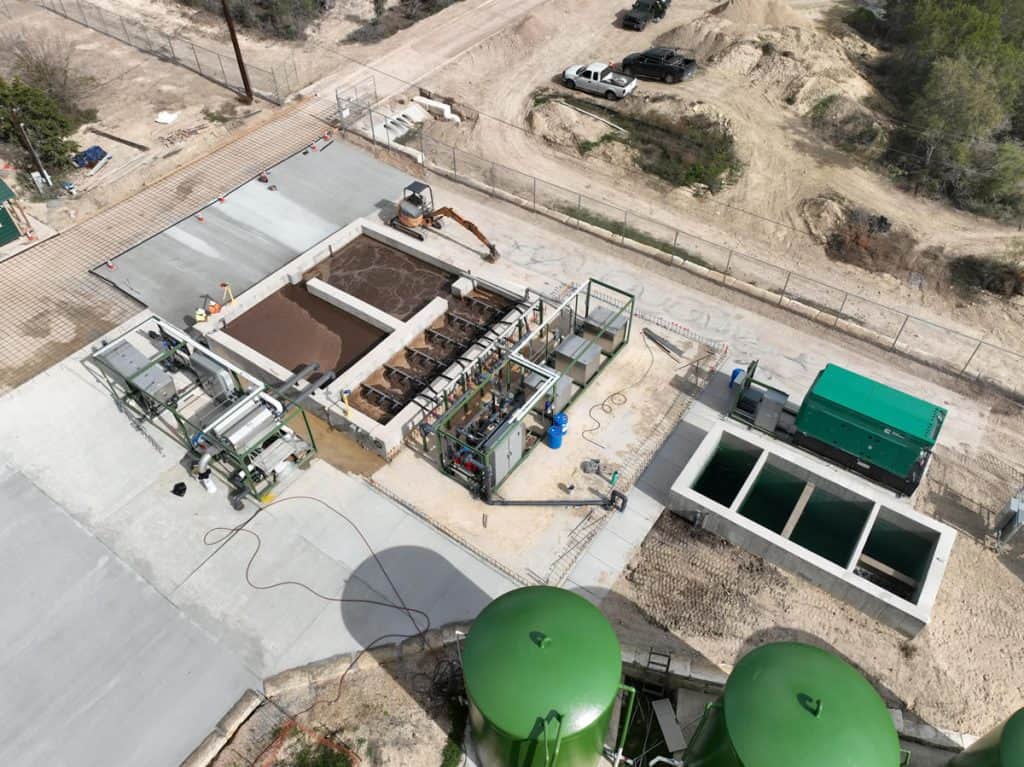
Every hotel, RV resort, event venue, campground, and shopping center generates wastewater — and in a growing number of locations, connecting to a municipal sewer simply isn’t an option. Whether your facility sits beyond the reach of city infrastructure or local capacity is tapped out, a commercial wastewater treatment system lets your project move forward on its own terms: treating wastewater on-site, meeting state discharge standards, and in many cases turning that water into a reusable resource.
This guide explains what commercial wastewater treatment systems are, how they differ from industrial and municipal plants, which technologies are available, and what to expect from permitting through operation.
What Is a Commercial Wastewater Treatment System?
A commercial wastewater treatment system is an on-site facility that treats wastewater generated by businesses and commercial properties — hotels, resorts, RV parks, restaurants, office campuses, retail centers, schools, churches, and event venues. Unlike industrial waste streams, commercial wastewater is primarily domestic in character: restrooms, kitchens, laundry, and cleaning operations. Flows typically range from a few thousand to several hundred thousand gallons per day.
The goal is to treat that water to the standard required by your state — and increasingly, to a quality high enough that it can be reused on-site for irrigation, cooling, or other non-potable purposes instead of being discharged and lost.
Commercial vs. Industrial vs. Municipal: What’s the Difference?
These terms are often used interchangeably, but they describe very different treatment challenges:
- Commercial systems handle domestic-strength wastewater from businesses. The design challenge is usually flow variability (weekends, seasons, events) and limited site footprint — not waste strength.
- Industrial systems treat process water from manufacturing, food processing, or energy operations. These streams often carry high organic loads (BOD/COD), fats and oils, or chemical constituents that require specialized pretreatment. If that sounds like your facility, see our page on wastewater treatment for industrial facilities.
- Municipal systems serve entire communities under a public utility. Our municipal wastewater reuse systems page covers that model in depth.
Correctly classifying your project matters, because it drives everything downstream: the technology selection, the permit pathway, and the budget.
Treatment Technologies for Commercial Facilities
Three technologies dominate the commercial space:
Conventional Activated Sludge (CAS)
The traditional approach: biological treatment followed by clarifiers for settling. Proven and familiar, but it requires a large footprint, and effluent quality is generally not high enough for direct reuse without additional filtration and disinfection stages.
Sequencing Batch Reactors (SBR)
A batch-mode variation of activated sludge that combines treatment and settling in a single tank. More compact than CAS, but effluent quality still varies with load — a real concern for commercial facilities with seasonal or weekend-driven flow swings.
Membrane Bioreactor (MBR)
An MBR system combines biological treatment with membrane filtration in one process, physically filtering the treated water through membranes instead of relying on gravity settling. The result is consistently high-quality effluent — clear, low in solids and pathogens — in a footprint dramatically smaller than conventional plants. That combination of small footprint and reuse-grade water quality is why MBR has become the technology of choice for commercial projects. For a detailed side-by-side, read our comparison of MBR vs. conventional activated sludge.
Why Footprint Matters for Commercial Projects
Land is revenue for a commercial property. Every square foot dedicated to a treatment plant is a square foot not generating income as parking, amenity space, or leasable area. MBR plants can be containerized or housed in compact building enclosures, and because the membranes replace large clarifier basins, the total site area required is a fraction of a conventional plant. For phased developments, modular MBR trains also allow capacity to grow with occupancy instead of overbuilding on day one.
From Wastewater to Asset: Reuse Options
The highest-quality effluent opens the door to beneficial reuse — and this is where a commercial treatment system stops being a cost center and starts paying for itself:
- Landscape and golf course irrigation — offset potable water purchases for green space.
- Cooling tower makeup — a major water demand for hotels and office campuses.
- Decorative water features — ponds, wetlands, and amenity lakes.
- Fire suppression storage — a reliable on-site water reserve.
Reuse regulations vary by state, and Texas in particular has well-established pathways for beneficial reuse of treated effluent. Learn more about how MBR treatment supports water reuse and compliance.
Permitting: The Step That Makes or Breaks Your Timeline
For most commercial projects, permitting — not construction — is the longest lead-time item. Discharge permits, land application permits, and reuse authorizations each follow different regulatory tracks, and choosing the wrong pathway early can cost months. This is why we recommend engaging a wastewater permitting team before finalizing site plans: the disposal strategy often shapes the site layout itself.
What Does a Turn-Key Commercial System Include?
A true turn-key delivery covers the full lifecycle under one point of responsibility:
- Permitting — regulatory strategy and application management.
- Design — process engineering sized to your actual flows and disposal pathway.
- Construction — fabrication, installation, and commissioning.
- Operations — ongoing operational support so your staff never has to become wastewater experts.
Splitting these phases among separate vendors is where commercial projects most often lose time and money — gaps between the engineer’s design, the contractor’s build, and the operator’s reality. We break down how to evaluate providers in our turnkey wastewater treatment plant buyer’s guide.
What Drives the Cost of a Commercial System?
Every project is different, but five factors consistently drive the budget:
- Design flow — peak gallons per day, including seasonal swings.
- Effluent standard — discharge-only vs. reuse-grade quality.
- Disposal pathway — surface discharge, land application, or beneficial reuse.
- Site conditions — available footprint, soils, and utility access.
- Delivery model — turn-key single-source vs. multi-vendor coordination.
The most reliable way to control cost is to lock in the disposal pathway and effluent standard early — everything else in the design flows from those two decisions.
Proven in the Field
reUse has delivered MBR-based treatment systems across Texas and beyond — from containerized plants for phased developments to full water reclamation facilities. Explore our completed projects to see systems similar to what your facility may need.
Frequently Asked Questions
How much space does a commercial wastewater treatment system require?
It depends on flow and technology, but MBR systems typically require 30–50% less land than conventional activated sludge plants of the same capacity. Smaller commercial systems can be fully containerized, fitting within a standard equipment yard.
Can treated commercial wastewater be reused for irrigation?
Yes. MBR effluent routinely meets the water quality standards required for landscape and golf course irrigation in most states, including Texas. The specific authorization required depends on your state’s reuse regulations.
How long does it take to permit and build a commercial system?
Permitting is usually the critical path and can take from several months to over a year depending on the discharge pathway and state. Design and construction of a packaged MBR plant typically move faster than the permit itself — which is why starting the regulatory process early is essential.
What contractors offer turnkey wastewater facility delivery?
Look for firms that hold single-source responsibility across permitting, design, construction, and operations — rather than engineering-only or construction-only providers. reUse delivers all four phases in-house, backed by more than 150 years of combined wastewater experience.
Is MBR worth the investment for a commercial facility?
For most commercial projects, yes. The smaller footprint preserves revenue-generating land, the reuse-grade effluent can offset potable water costs, and consistent water quality simplifies compliance — advantages that typically outweigh the higher upfront membrane cost over the life of the facility.
Ready to explore a treatment solution for your commercial property? Our team can evaluate your site, flows, and disposal options and recommend the right path forward. Contact reUse today for a no-obligation consultation.

