
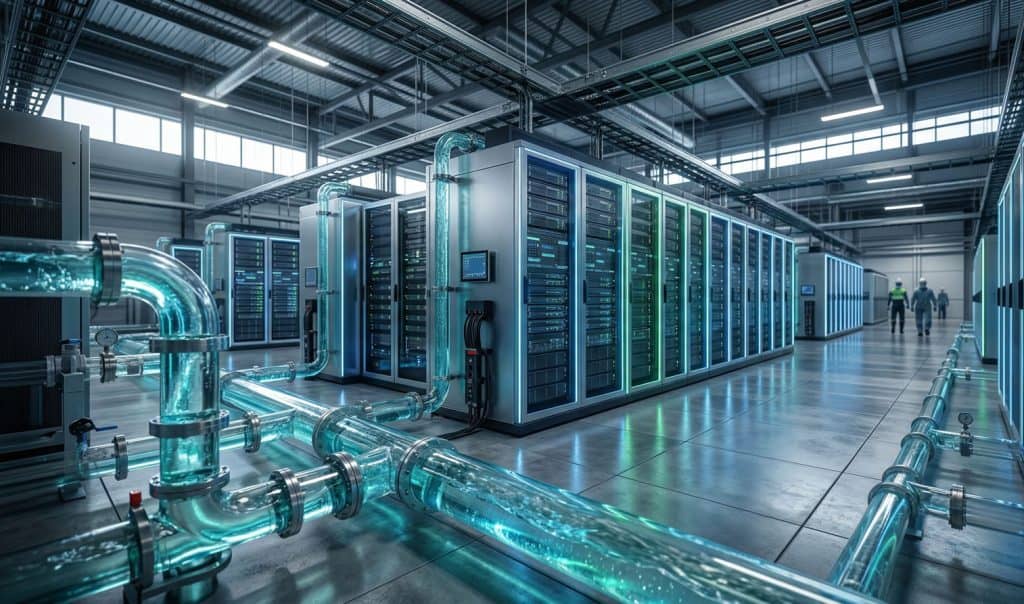
A hyperscale data center campus withdraws on the order of 550,000 gallons of water a day — roughly 200 million gallons a year. A smaller wholesale or retail facility averages closer to 18,000 gallons a day. Around 80 percent of that water evaporates in the cooling towers and is gone. The remaining 20 percent leaves as blowdown, and that is the stream where onsite reuse actually begins.
Most coverage of data center water stops at the first number and treats it as a scandal. The more useful question for anyone actually siting or operating a facility is narrower: how much of that water is recoverable, what has to happen to recover it, and when does it make financial sense? This article covers the numbers first, then the part almost nobody writes about water reuse systems for data centers and where the real constraint sits.
The numbers, by facility size
Direct, onsite water withdrawal. These figures vary enormously with climate, cooling design and how the operator counts, so treat them as orders of magnitude rather than specifications.
| Facility | Water withdrawn | Source |
|---|---|---|
| Hyperscale campus (Google example) | ~550,000 gal/day ≈ 200M gal/year | Dgtl Infra |
| Large facility, upper end | Up to 5M gal/day ≈ 1.8B gal/year | Washington Post, 2023 |
| Wholesale / retail facility, average | ~18,000 gal/day ≈ 6.57M gal/year | Dgtl Infra |
| All US data centers combined (2021) | 449M gal/day ≈ 163.7B gal/year | Nature, via EESI |
| Northern Virginia cluster (2023) | ~2B gal/year, +63% vs 2019 | EESI |
Those are direct withdrawals only. The indirect figure is larger and rarely quoted: generating the electricity that powers US data centers consumed an estimated 211 billion gallons in 2023, at a national average of roughly 1.2 gallons per kilowatt-hour. A facility that cuts its onsite water use by running hotter and harder on air cooling does not necessarily cut its total water footprint it may simply move the water upstream to the power plant.
WUE: the number that lets you compare facilities
Gallons per day tells you almost nothing without knowing the size of the load. Water Usage Effectiveness — WUE, expressed in liters of water per kilowatt-hour of IT load — is the metric that makes two facilities comparable.
| Benchmark | WUE (L/kWh) | Context |
|---|---|---|
| Industry average | ~1.80 | Reported by Meta |
| Meta, newest facilities | 0.20 | Claimed ~80% better than average |
| AWS, reported fleet average | 0.19 | Improved from 0.25 the prior year |
Read a very low WUE carefully. Heat has to go somewhere. A facility that reaches near-zero water use on site is usually spending more electricity to do it, which pushes water consumption back into the generation mix. The honest framing is a trade-off curve between water, power and capital — not a single number to optimize. The same logic applies when choosing a treatment technology; we walk through a version of that trade-off in MBR vs. conventional activated sludge.
Where the water actually goes
In an evaporative cooling system the withdrawn water splits into two very different streams:
- Evaporation roughly 80 percent. This leaves as water vapor and is not recoverable on site by any treatment process. It is a genuine consumptive loss.
- Blowdown roughly 20 percent. As water evaporates, dissolved solids concentrate in the remaining loop. Blowdown is the bleed that keeps that concentration under control. It leaves the site as liquid, usually to the municipal sewer.
That distinction is the whole argument. Evaporation is a water accounting problem. Blowdown is a wastewater problem, and wastewater problems have engineering solutions.
Why the sewer, not the water supply, is usually the binding constraint
Site selection conversations tend to focus on whether there is enough water. In fast-growing markets the harder question is where the blowdown goes.
- Collection system capacity. A campus discharging hundreds of thousands of gallons a day can exceed what the receiving utility can accept, particularly in the semi-rural areas where large campuses get sited.
- Discharge limits. Blowdown is concentrated by design — elevated TDS, conductivity, and whatever scale and corrosion inhibitors the cooling program uses. Those parameters show up in industrial discharge permits.
- Surcharges. Utilities price high-strength and high-volume discharge accordingly, and that line item compounds over a 15-year operating life.
- Cycles of concentration. Running more cycles reduces blowdown volume but concentrates it further and raises scaling and corrosion risk. You can trade volume for strength, but not eliminate the stream.
A project can be fully financed, powered and permitted for construction and still stall because a utility will not accept the discharge. That is the constraint onsite reuse is actually solving.
How much of it can be reused
Split the answer by stream, because the honest answer is different for each.
| Stream | Recoverable? | What it takes |
|---|---|---|
| Cooling tower evaporation | No | Consumptive loss; only reducible by changing the cooling design |
| Cooling tower blowdown | Yes, substantially | Treatment for solids and dissolved constituents, then polishing to meet makeup water quality |
| Campus sanitary wastewater (offices, restrooms, kitchens) | Yes | Biological treatment — MBR handles this stream well and produces effluent suitable for cooling makeup or irrigation |
| Stormwater and condensate | Often, seasonally | Collection, storage and disinfection; supplements makeup rather than replacing it |
Four things, and the third and fourth are where most projects come apart.
- Treatment. A membrane bioreactor handles the biological load and the solids in a footprint that fits on a constrained campus, producing a consistent, high-clarity effluent. Depending on the target makeup quality, a polishing step for dissolved solids follows.
- Space and siting. Compact and modular matters here. Land on a data center campus is allocated to revenue-generating white space; the treatment plant has to justify its footprint.
- Permitting. Discharge authorization, reuse authorization and state-specific water quality rules, each with its own timeline. This is routinely the longest pole in the schedule, and it belongs on the critical path from day one rather than after design. See permitting.
- Operations. A data center runs 24/7 and has no tolerance for an upset that interrupts cooling. Someone has to operate the plant to that standard for its whole life — which is a different commitment from buying equipment. See operations and maintenance.
The same economics show up in other high-volume, high-strength settings — see industrial and commercial facilities — and examples of delivered systems are on our projects page.
Frequently Asked Questions
How much water does a data center use per day?
A hyperscale campus withdraws on the order of 550,000 gallons per day, roughly 200 million gallons per year. Smaller wholesale and retail facilities average about 18,000 gallons per day. The largest facilities have been reported at up to 5 million gallons per day. Figures vary widely with climate and cooling design.
How much water does an AI data center use compared with a traditional one?
AI training and inference workloads raise rack power density, and water use scales with the heat that has to be rejected rather than with the workload itself. Comparing facilities on Water Usage Effectiveness (liters per kilowatt-hour of IT load) is more meaningful than comparing total gallons, because a denser facility does more computing with the same water.
Can data center cooling water be recycled or reused?
The portion that evaporates cannot be recovered on site. The blowdown stream can be treated and returned to cooling makeup, and campus sanitary wastewater can be treated and reused as well. How much this reduces net withdrawal depends on source water quality, cycles of concentration and the makeup quality the cooling system requires.
What is a good WUE for a data center?
The reported industry average is around 1.80 L/kWh. Leading operators report figures near 0.20 L/kWh. A very low WUE often reflects a design that uses more electricity to avoid evaporation, which moves water consumption upstream to power generation rather than eliminating it.
Do closed-loop or air-cooled data centers use no water?
They use very little water on site. They typically consume more electricity for the same IT load, and generating that electricity consumes water — roughly 1.2 gallons per kilowatt-hour on the US average. The total water footprint is lower in some cases and comparable in others.
Who permits and operates an onsite water reuse system?
Permitting runs through the state environmental agency and the local utility, with requirements that differ by jurisdiction. Operation requires licensed operators and a maintenance program matched to a 24/7 facility. Some providers, including reUse, deliver permitting, design, construction and long-term operations as a single scope.
Siting a data center and unsure where the blowdown goes? reUse permits, designs, builds and operates onsite MBR treatment and reuse systems, with delivered projects in Texas and Pennsylvania. Talk to our permitting team.

