
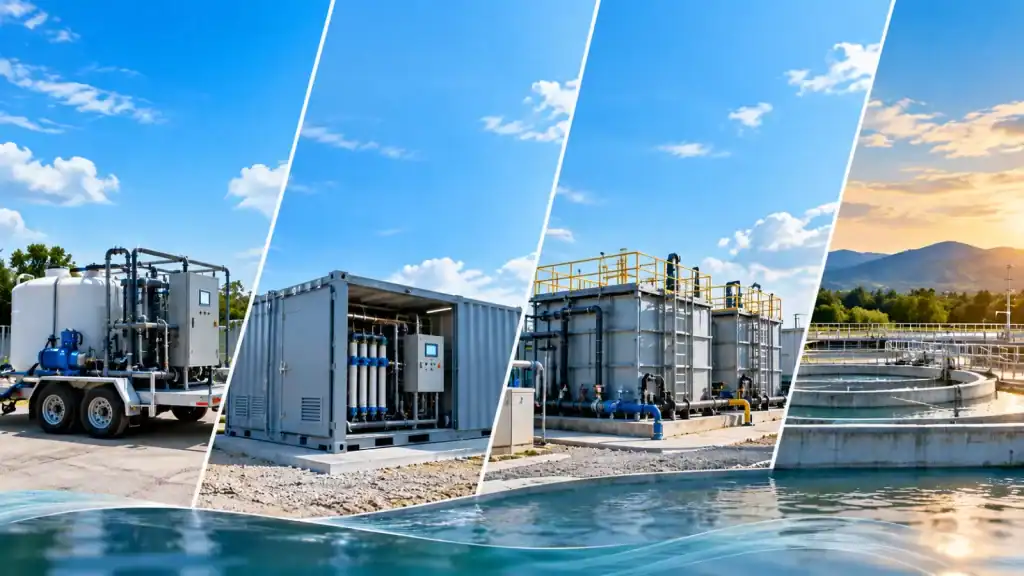
Portable wastewater treatment covers four very different things, and the differences matter more than the shared label. A trailer-mounted rental unit, a containerized package plant, a permanent-grade plant installed temporarily and a phased permanent build all get described the same way — and they suit completely different problems.
The question behind the search is usually the same, though: capacity is needed before the permanent plant will be ready. This article separates the options, says what each one is actually for, and covers the constraint that decides most of them. If you already know you need interim capacity, our temporary and phased wastewater treatment page covers how we approach it.
Portable, mobile, temporary, containerized: four words, four meanings
These get used interchangeably and should not be.
| Term | What it actually describes |
|---|---|
| Portable / mobile | How the unit moves. Trailer, truck or skid. |
| Containerized | How it is built. Assembled and tested inside a shipping container at the factory. |
| Temporary | How long it serves. Says nothing about construction or quality. |
| Modular / phased | How it grows. Capacity added in stages against a planned buildout. |
A containerized plant can be permanent. A temporary plant can be site-built. Getting the vocabulary straight is the first step to comparing quotes that are actually comparable.
The four options, compared
| Option | Typical duty | Fits when |
|---|---|---|
| Trailer or skid rental unit | Weeks to months, construction and event duty | Short gap, modest flow, no permit-grade effluent requirement |
| Containerized package plant | Months to permanent | Constrained or remote site; factory build beats site build on schedule |
| Permanent-grade plant, temporary install | A year or more | Homes are occupied and the effluent has to meet a permit limit |
| Phased permanent plant | Life of the development | The buildout schedule is known and capacity can be added in stages |
Most developments end up using two of these in sequence: something interim, then the permanent plant it was always meant to hand over to.
The question that decides it: how long is “temporary”?
This is where projects go wrong. A unit specified for a three-month gap and then kept in service for two years will not hold effluent quality, and the operating cost of a rental stretched past its intended duty tends to overtake what the right equipment would have cost outright.
So answer it honestly before specifying anything. Not the optimistic schedule — the one that assumes permitting takes as long as permitting takes.
What each option costs you
- Rental units are fast and cheap to mobilize, and every dollar leaves with
the unit. They rarely produce permit-grade effluent. - Containerized plants compress the construction schedule and are relocatable,
at the cost of a fixed footprint and capacity you cannot change later. - Temporary permanent-grade installs give you effluent quality and duration,
but you are building twice. - Phasing puts every dollar into the asset that stays, and asks for a buildout
forecast you may not have yet.
Permitting does not get shorter because the plant is temporary
Obligations follow the discharge, not the permanence of the equipment. A temporary plant discharging to surface water or to a sewer carries the same categories of requirement as a permanent one — see the EPA’s NPDES permit basics for how discharge authorization works.
In practice the permit, not the equipment, usually sets the date capacity comes online. The useful move is to permit the interim plant and the permanent one as a single programme rather than as two efforts separated by a year. Our permitting work is normally scoped that way.
What this looks like in practice
At Hickory Ridge in Elmendorf, Texas, a land developer needed service for the first 135 to 179 homes while the permanent plant was still under construction. A 30,000 GPD temporary MBR carried that load, with a 250,000 GPD Phase 1 plant following behind it.
The interim unit did the one thing it was there to do: it took wastewater capacity off the critical path so closings could proceed. Other delivered projects show the containerized and phased versions of the same idea.
Questions to answer before you choose
- How many connections at first occupancy, and how many at buildout?
- What is the realistic permitting timeline, not the optimistic one?
- Where does the effluent go, and what limit does it have to meet?
- How long will the interim plant actually run?
- Is there space on site for interim and permanent plants at the same time?
- Who operates it, and is that the same team that will run the permanent plant?
- What happens to the interim equipment afterwards — relocated, returned or retired?
A membrane bioreactor answers the effluent-quality question in a compact footprint, which is why it shows up in both the interim and the permanent stage on most of these projects.
Frequently asked questions
What is portable wastewater treatment?
An umbrella term for any system that is not built in place: trailer or skid-mounted rental units, containerized package plants assembled and tested at the factory, and permanent-grade plants installed on a temporary basis. The options differ far more in duty and effluent quality than the shared label suggests.
What is the difference between portable, mobile, temporary and containerized?
Portable and mobile describe how a unit moves. Containerized describes how it is built — skid-mounted inside a shipping container, factory-assembled. Temporary describes how long it serves. A containerized plant can be permanent, and a temporary plant can be site-built, so the terms are not interchangeable.
How long can a temporary wastewater plant stay in service?
That depends on what it is. A trailer unit sized for weeks of construction duty is a different machine from a containerized MBR sized to serve homes for a year or more while a permanent plant is built. Match the equipment class to the actual duration, not to the word “temporary”.
Does a temporary plant still need a discharge permit?
Yes. Permitting obligations follow the discharge, not the permanence of the equipment. Build the permitting timeline into the schedule from the start and expect it rather than the equipment to drive the date capacity comes online.
Is it cheaper to install temporary capacity or to phase the permanent plant?
When the buildout schedule is known, phasing the permanent plant is usually the better value, because every dollar goes into the asset that stays. A temporary plant earns its cost when the gap is real and short, and when occupancy cannot wait for the permanent plant to commission.
What effluent quality can a portable system produce?
It ranges widely. Basic rental units are built for containment and coarse treatment; a containerized membrane bioreactor can produce a consistently high-quality effluent suitable for reuse. If the effluent has to meet a permit limit or be reused, that narrows the options quickly.
Facing a gap between first occupancy and the permanent plant? Send us your phasing plan and first-occupancy date and we will tell you what it takes to have capacity ready. Talk to our team.

