

Choosing the right wastewater treatment process is one of the most important decisions in any municipal, commercial, or industrial project. Two of the most common biological treatment approaches today are Membrane Bioreactors (MBR) and Conventional Activated Sludge (CAS) systems.
Both are proven technologies. Both can meet regulatory requirements. But they are not interchangeable.
The right choice depends on space constraints, effluent quality requirements, reuse goals, operational complexity, and long-term lifecycle cost. This guide breaks down the differences clearly and practically, so you can determine which system fits your project.
Quick Comparison: MBR vs Conventional Activated Sludge
| Factor | MBR | Conventional Activated Sludge |
|---|---|---|
| Footprint | Very compact | Large |
| Effluent Quality | Very high, reuse-ready | Moderate to high |
| Solids Removal | Membrane barrier | Gravity clarification |
| Reuse Applications | Excellent | Limited without tertiary treatment |
| Capital Cost | Higher upfront | Lower upfront |
| Operational Complexity | Moderate | Moderate |
| Sludge Production | Lower | Higher |
| Process Stability | Very stable | Sensitive to load changes |
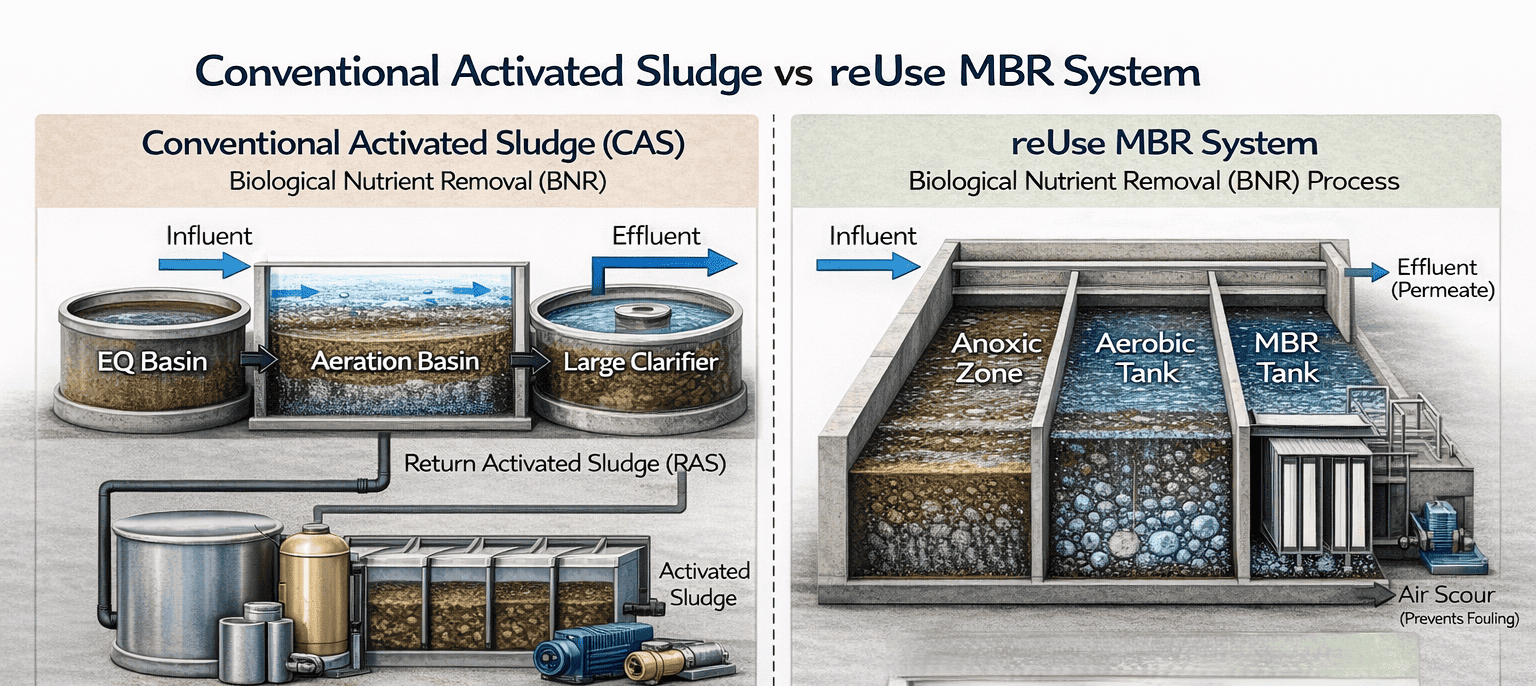
Overview of Conventional Activated Sludge (CAS) Systems
Conventional Activated Sludge systems have been the backbone of wastewater treatment for more than a century. Developed in the early 1900s, CAS relies on aerobic microorganisms to biologically degrade organic pollutants.
How CAS Works
A typical CAS system includes:
- Primary treatment to remove large solids
- Aeration basins where wastewater is mixed with activated sludge
- Secondary clarifiers where biological solids settle
- Return Activated Sludge (RAS) recycled back to the aeration basin
- Waste Activated Sludge (WAS) removed for disposal or digestion
- Additional disinfection and often tertiary treatment if higher-quality effluent is needed
The system depends heavily on gravity settling to separate treated water from biomass.
Strengths of CAS
CAS systems are:
- Well understood and widely accepted by regulators
- Suitable for very large municipal flows
- Lower in initial capital cost compared to advanced systems
Limitations of CAS
CAS systems require:
- Large land area for aeration and clarification
- Larger concrete structures and more extensive site work
- Clarifiers and additional downstream processes
- Careful control to prevent sludge bulking or foaming
- Additional tertiary treatment if reuse quality effluent is required
Effluent quality can fluctuate during peak flows or influent changes, which can be a challenge for facilities with variable loading.
Overview of Membrane Bioreactor (MBR) Systems
Membrane Bioreactors combine traditional biological treatment with physical membrane filtration, replacing clarifiers entirely.
How MBR Works
An MBR system integrates:
- A Biological Nutrient Removal (BNR) Process using Anoxic and Aerobic process
- Submerged Membranes that physically separate solids
- Continuous filtration producing high quality effluent
- UV Disinfection for a final reclaimed water treatment
The membrane acts as a physical barrier, preventing suspended solids, bacteria, and most pathogens from passing through.
Key Advantages of MBR
MBR systems provide:
- Exceptional effluent quality suitable for reuse
- Much smaller footprint compared to CAS
- Higher sludge retention times (SRT), improving treatment efficiency
- Greater resilience to flow and load variations
Because clarification is membrane-based rather than gravity-based, performance remains consistent even under challenging conditions.
Efficiency and Treatment Performance Comparison
Organic and Solids Removal
MBR systems typically operate at higher mixed liquor concentrations and longer sludge ages. This improves breakdown of complex organics and results in near-zero suspended solids in the effluent.
CAS systems can achieve high removal rates but are more sensitive to hydraulic and organic shocks.
Nutrient Removal
Both systems can be designed for nitrogen and phosphorus removal. However, MBR systems often achieve more consistent nutrient performance due to process stability and precise control.
Effluent Consistency
One of the most significant differences is consistency. MBR systems deliver stable, high-quality effluent regardless of influent variability. CAS systems can experience performance swings during storms, peak loads, or seasonal changes.
Cost Considerations: CAPEX vs Lifecycle Cost
Capital Cost
MBR systems generally have higher upfront costs due to membranes and specialized equipment. CAS systems usually require less initial investment.
Operating and Maintenance Costs
When evaluated over the full lifecycle:
- MBR systems often reduce downstream treatment costs
- Reuse-ready effluent eliminates or minimizes tertiary treatment
- Smaller footprint lowers civil construction and land costs
Membrane replacement is a long-term consideration, typically every 5 to 10 years, depending on operation and maintenance practices.
CAS systems incur ongoing costs related to sludge handling, clarifier maintenance, and process instability.
Environmental and Sustainability Considerations
MBR systems align well with modern sustainability goals:
- High-quality effluent supports water reuse
- Reduced land footprint minimizes environmental impact
- Lower sludge volumes reduce disposal needs
CAS systems remain effective but generally require more space and produce higher sludge volumes.
As water reuse regulations tighten, MBR systems are increasingly favored in regions facing water scarcity or strict discharge limits.
Maintenance and Operational Complexity
MBR Operations
MBR systems require:
- Routine membrane monitoring
- Periodic physical and chemical cleaning
- Automated controls for optimal performance
Advances in membrane design and automation have significantly reduced operator burden.
CAS Operations
CAS systems demand:
- Continuous monitoring of sludge settleability
- Aeration control to prevent bulking or foaming
- Extensive sludge management infrastructure
Both systems require skilled operators, but MBR systems tend to deliver more predictable results with fewer emergency interventions.
How reUse Approaches the MBR vs CAS Decision
At reUse, the choice between MBR and CAS is never about pushing a single technology. It is about matching the process to the project.
MBR Is Often the Right Choice When:
- Space is limited
- Water reuse is a priority
- Effluent quality must be consistently high
- Influent characteristics vary significantly
CAS May Be the Better Option When:
- Land is readily available
- Flows are very large and stable
- Reuse is not a current or future requirement
- Capital budget is the primary constraint
In many projects, hybrid or phased approaches also make sense.
Real-World Applications
MBR systems are commonly used in:
- Commercial buildings and mixed-use developments
- Hotels and resorts
- Industrial facilities with reuse goals
- Master-planned communities
- Municipalities
CAS systems continue to serve:
- Facilities with abundant land
- Applications where reuse is not required
Final Thoughts: Making the Right Choice
There is no universal answer to the MBR vs CAS question.
MBR systems deliver superior effluent quality, compact design, and reuse readiness, making them ideal for modern, sustainability-driven projects. Conventional Activated Sludge remains a proven and cost-effective solution for large, stable flows where land and discharge limits are less restrictive.
The right decision comes from understanding not just the technology, but how it fits into your long-term operational, regulatory, and reuse strategy.
At reUse, we evaluate wastewater treatment systems holistically, from influent characteristics to lifecycle cost, to design solutions that work today and adapt for tomorrow.

